TL;DR — Quick Answer
Popsicle output is mould count times completed freeze cycles — not one number on a box. The AXOSPRO single-head machine is rated up to 4,800 pieces per 24 hours with 40 moulds (3,600 with 30), running to -25 C.
- Formula: output = moulds per batch × completed freeze cycles in the period
- AXOSPRO single-head: up to 4,800 pieces / 24h with 40 moulds, or 3,600 with 30 moulds, to -25 C
- Freeze time: depends on recipe and starting mix temperature — time three of your own batches
- Plumbing: none needed: poured by hand, no water line, no drain
How many popsicles can a commercial machine make per day?
Popsicle output is not a single rating — it is arithmetic:
Output = number of moulds per batch × number of completed freeze cycles in the period.
That is why two machines with the same headline daily figure can behave very differently in your kitchen. One might run more moulds more slowly; the other fewer moulds faster. For planning a shift, the cycle count is the number you need, and it is specific to your recipe.
Real figures for the AXOSPRO single-head machine
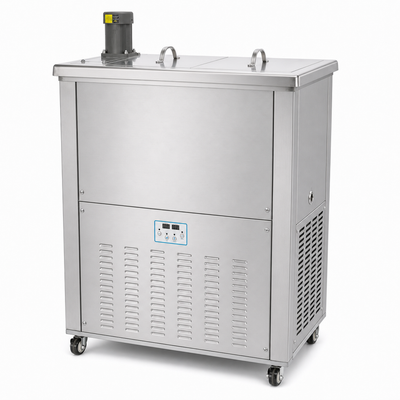
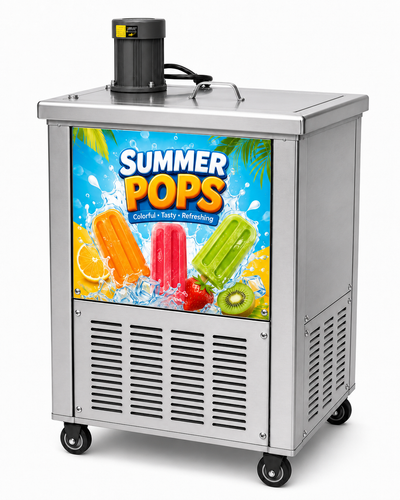
The AXOSPRO single-head popsicle machine (model BQL-A11-6) is specified as:
- Up to 4,800 pieces per 24 hours with 40 moulds
- Up to 3,600 pieces per 24 hours with 30 moulds
- Down to -25 C operating temperature
Two honest caveats, because this is the number buyers get wrong. The daily figure assumes continuous operation across 24 hours with batches turned around promptly. And your actual throughput depends on your recipe — a fruit-water base and a cream or yogurt base do not freeze at the same rate.
How long does one batch take to freeze?
Do not plan a business on a published freeze time. Run three batches through your own machine with your own recipe, at the temperature your mix will actually be at the start of a shift, and time them.
- Prepare the mix the way you will in service — same recipe, same starting temperature.
- Fill the moulds and start the cycle.
- Time to a properly set product, not to "mostly frozen".
- Repeat three times and take the average.
That average is your planning number. Everything downstream — batches per shift, how many mould sets you need, whether you can fulfil a wholesale order — is arithmetic from it.
What is the difference between 30 and 40 moulds?
This is a working-style decision as much as a throughput one.
- Long single-flavour runs — more moulds per batch is straightforwardly better, because the overhead is the cycle, not the mould.
- Multiple flavours or test batches — a smaller mould set gives you more flexibility and less committed product per run.
The mould count also changes stick spacing and format, so if you have packaging or a retail presentation in mind, check that the format matches before you buy on throughput alone.
How cold does a popsicle machine need to get?
A domestic freezer running at around -18 C will eventually freeze a popsicle, but slowly — and slow freezing grows large ice crystals, which is what makes a homemade popsicle grainy and a commercial one smooth. Running to -25 C sets the product fast enough to keep the texture right and turns batches around quickly enough to be commercially useful.
Match your recipe to the capability: water-based and dairy-based recipes behave differently through the freeze, and a cream base generally needs more from the machine than a fruit-water one.
Can you run a popsicle machine from home or a market stall?
Popsicle machines are among the most flexible equipment in this category because the mix is poured in by hand. There is no water line to run and no floor drain to find — you need power, space, and a sink nearby for rinsing moulds.
That is what makes them realistic for home-based production, market stalls and seasonal kiosks, where plumbing simply is not available. Check the power requirement against what your venue actually has before ordering, and confirm the licensing rules for producing food for sale where you are.
Related reading
- Popsicle machine output and moulds
- Equipment for food trucks and small shops
- AXOSPRO single-head popsicle machine
- AXOSPRO double-head popsicle machine
- Shop popsicle machines
Frequently asked questions
How many popsicles can a commercial popsicle machine make per day?
It is mould count multiplied by completed freeze cycles, not a single number on a box. The AXOSPRO single-head popsicle machine (BQL-A11-6) is specified at up to 4,800 pieces per 24 hours with 40 moulds, or up to 3,600 pieces with 30 moulds, running to -25 C. Your real number depends on your recipe, your starting mix temperature and how quickly you turn batches around.
How long does one batch take to freeze?
It depends on the recipe, the volume in each mould, and the temperature of the mix going in — a fruit-water base freezes faster than a cream or yogurt base. The practical way to get your real cycle time is to run three batches through your own machine with your own recipe and time them. Use that number for planning rather than any published figure.
What is the difference between 30 and 40 moulds?
It changes your batch size and therefore your throughput per cycle, and it changes the stick spacing and mould format. If you are producing for a single flavour run, more moulds per batch is straightforwardly better. If you are running multiple flavours or smaller test batches, a smaller mould set can be easier to work with.
How cold does a popsicle machine need to get?
The AXOSPRO single-head model runs to -25 C, which is well below what a domestic freezer delivers and is why commercial units set a popsicle properly rather than slowly. Water-based and dairy-based recipes need different handling, so match your recipe to the machine capability rather than assuming one setting covers both.
Do popsicle machines need a water line and a drain?
No. The mix is poured into the moulds by hand, so a popsicle machine needs no plumbed water supply and no floor drain. You need power, counter or floor space, and a sink nearby for rinsing moulds. Only machines that make ice from water need plumbing.
Can I run a popsicle machine from home or a market stall?
Popsicle machines are among the more portable options in this category precisely because they need no plumbing — a standard power supply and space for the unit is the main requirement. Check the power requirement against what your venue actually has before ordering, and confirm any licensing rules that apply to producing food for sale at your location.
AXOSPRO support: 8245 105th Ave, Vero Beach, FL 32967 · vliang@axospro.com · 1-772-258-0386