TL;DR — Quick Answer
Most businesses underestimate their ice requirement by 30–50%. Size production for average daily use and storage for peak demand.
- Formula: ice per customer × peak daily covers × 1.2 for spillage and meltage.
- Cocktail bar: 1.5–2.5 kg per customer.
- Restaurant with table water: 0.5–1 kg per cover, plus service ice behind the bar.
- Cafe and juice bar: 0.8–1.5 kg per customer, higher in summer.
- Hotel: 2–3 kg per guest per day across rooms, restaurant and banqueting.
- Benchmarks: a 200-seat restaurant typically needs 300–450 kg/day; a busy bar 150–250 kg/day.
- Storage rule: storage bin capacity equal to roughly half your daily production.
- Heat derating: rated output assumes moderate ambient and cold feed water — hot kitchens produce less.
Most businesses underestimate their ice requirement by 30 to 50 percent. A safe method: count the ice you use per customer, multiply by peak daily covers, add 20 percent for spillage and meltage in the bin, then match that figure to a machine rated for 24-hour production. A 200-seat restaurant typically lands between 300 and 450 kg per day; a busy bar between 150 and 250 kg.
Step 1: ice per customer, by business type
- Cocktail bar: 1.5 to 2.5 kg per customer. Shaken drinks and large format service push this higher.
- Restaurant with table water: 0.5 to 1 kg per cover, plus service ice behind the bar.
- Cafe and juice bar: 0.8 to 1.5 kg per customer, higher in summer and for iced drinks.
- Hotel: 2 to 3 kg per guest per day across rooms, restaurant and banqueting.
- Healthcare and care facilities: plan per bed, not per cover, and confirm the figure with your clinical team.
Step 2: convert to machine rating
Machine output is quoted in kg per 24 hours at a stated ambient and water temperature. Two corrections matter:
- Production runs 24 hours, consumption does not. A machine rated 450 kg per 24 hours produces roughly 19 kg per hour continuously, so overnight production refills the bin for the next service.
- Heat reduces output. Rated figures assume moderate ambient and cold feed water. In a hot kitchen or a tropical climate, derate by 15 to 25 percent. If the machine sits next to an oven, move it or size up.
Step 3: storage bin capacity is not optional
The bin decouples production from demand. Without adequate storage, you run dry at the peak even though the machine is technically large enough. A practical target is to hold 40 to 60 percent of daily demand in the bin. Machines with a built-in bin, such as 40 kg or 200 kg integrated units, remove the need for a separate purchase and simplify installation.
Step 4: air-cooled or water-cooled
- Air-cooled: simpler, no water line needed beyond the feed, lower running cost. Needs ventilation clearance and dumps warm air into the room.
- Water-cooled: quieter and no heat dumped into the workspace, but it consumes significantly more water and costs more to run. Used where ventilation is impossible or ambient heat is already extreme.
For most bars, cafes and restaurants, air-cooled is the correct default.
Step 5: installation checklist before delivery
- Potable water supply within reach, with a shut-off valve.
- Drain at floor level or a gravity drain point near the machine.
- Level floor; machines must sit flat for correct water distribution over the evaporator.
- Ventilation. Front-breathing units can sit flush against a wall, which recovers usable floor space.
- Correct voltage and a dedicated circuit. Confirm whether the site is 110V 60Hz or 220V 50 or 60Hz before ordering.
Frequently asked questions
Why does my ice machine run but make less ice in summer? Warmer ambient and warmer feed water both extend the freeze cycle. Derate the nameplate figure by 15 to 25 percent in hot conditions and size accordingly.
How often should a commercial ice machine be descaled? Every three to six months in hard water areas, or whenever production drops noticeably. Scale on the evaporator is the most common cause of declining output.
Should I buy cube or nugget ice for a bar? Full cube for slow dilution in spirits and cocktails. Nugget for blended drinks and healthcare, where a softer chewable ice is preferred.
Choosing your model
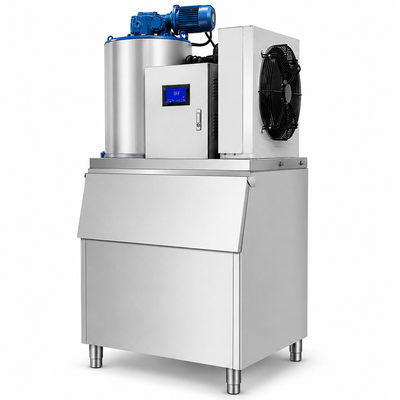
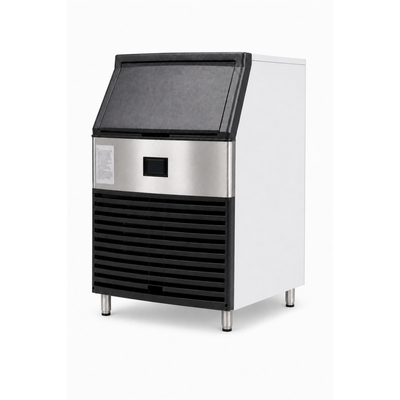
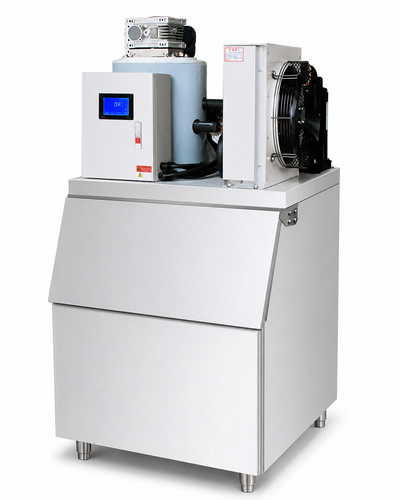
For compact sites, the Axospro IM-90 and IM-108 cover 95 to 110 kg per day with a built-in 40 kg bin. For full restaurant service, the Axospro IM-260 delivers up to 450 kg per day with a 200 kg bin in the same footprint class. Both are air-cooled and need no separate water line for condensing.
Frequently Asked Questions
How many pounds of ice per day does a restaurant need?
A casual full-service restaurant typically uses 1.5 to 2 pounds of ice per seat per day; a bar uses 3 to 5 pounds per seat; a quick-service restaurant uses 5 to 7 pounds per seat. Cold beverage programs and ice-bin displays add significantly on top.
How do I calculate ice storage capacity?
Multiply your peak-hour ice demand by the longest interval between ice deliveries or harvests (overnight is typical). Plan for at least 24 hours of storage at peak so a single harvest or delivery cycle covers a full busy day.
What is the rule of thumb for ice per customer?
For drinks only, plan 1 to 1.5 pounds of ice per customer. For salad bars, buffets or ice displays, plan 3 to 5 pounds per customer. For a mixed menu, combine by sub-area rather than averaging.
Should I size for peak or average demand?
Size production for average daily use and storage for peak. Storage bridges the gap during busy hours and protects you against harvest-cycle delays. A common rule is storage equal to half your daily production capacity.