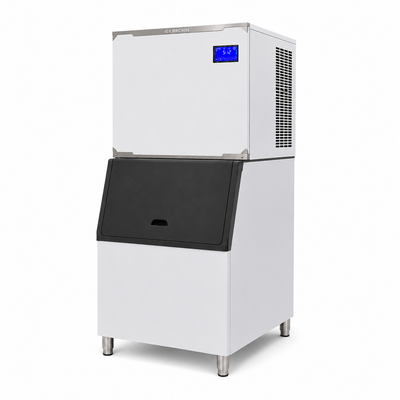
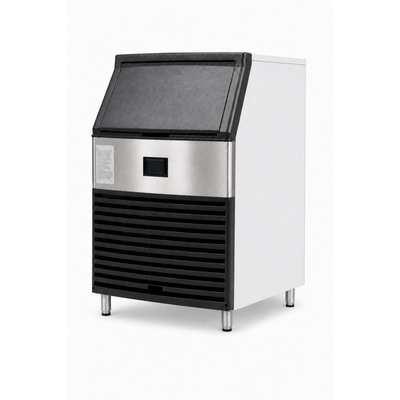
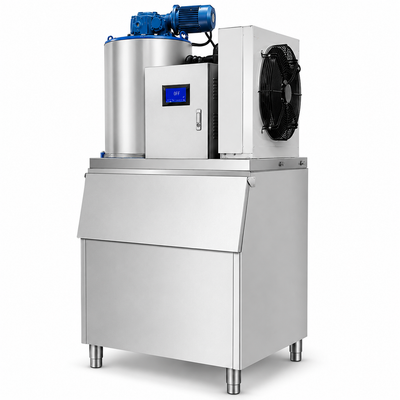
TL;DR — Quick Answer
Before delivery, confirm four things: a potable cold water line with adequate pressure, a gravity drain with an air gap, a dedicated electrical circuit matching the nameplate, and clearance around the condenser.
- Water line: 1/4 in. or 3/8 in. for undercounter units (~100 kg/day); 3/8 in. to 1/2 in. for large modular units (400 kg/day+).
- Water pressure: 1–5 bar (15–80 psi) for most units; 2–5 bar (30–80 psi) for large machines.
- Drain: gravity floor drain with an air gap. A pumped drain is an option only where gravity is impossible.
- Electrical: 115V/60Hz dedicated circuit for small undercounter units; 208–230V dedicated circuit for mid-size and large modular units.
- Clearance: rear and sides per the manual, plus front service access — tight enclosures trap heat, cut output and shorten compressor life.
- Ambient range: typically 10–38 °C (50–100 °F) for air-cooled machines.
- Outdoor use: only with a model rated for it, shaded and within the operating temperature range.
Short answer: A commercial ice machine needs a potable cold water line with adequate pressure, a gravity drain with an air gap, a dedicated electrical circuit matching the nameplate voltage, and enough clearance around the condenser for airflow. Getting these four right before delivery prevents most installation delays and protects your warranty.
This guide is for owners, general contractors and kitchen designers planning an installation. It covers air-cooled cube and flake machines, which are the majority of commercial installations. Always confirm the exact figures against the specification sheet for the model you are buying.
Typical requirements at a glance
| Requirement | Small undercounter (up to ~100 kg/day) | Mid-size modular (150-350 kg/day) | Large modular (400 kg/day and up) |
|---|---|---|---|
| Water line | 1/4 in. or 3/8 in. potable cold | 3/8 in. potable cold | 3/8 in. or 1/2 in. potable cold |
| Water pressure | 1-5 bar (15-80 psi) | 1-5 bar (15-80 psi) | 2-5 bar (30-80 psi) |
| Drain | Gravity floor drain or pumped | Gravity floor drain | Gravity floor drain, larger bore |
| Electrical | 115V / 60Hz dedicated circuit | 208-230V dedicated circuit | 208-230V, higher amperage |
| Clearance | Rear and sides per manual, front service access | Same, plus condenser intake space | Same, often with ducting consideration |
| Ambient range | 10-38°C (50-100°F) | 10-38°C (50-100°F) | 10-38°C (50-100°F) |
1. Location and clearance
- Level floor. Shims or adjustable legs must bring the cabinet level; an out-of-level machine produces uneven cubes and leaks.
- Condenser clearance. Air-cooled machines draw air in one side and discharge it out the other or out the front. Blocking either side, or boxing the machine in with a decorative surround, is the most common cause of low output.
- Service access. Leave enough room at the front or top to remove panels and lift the evaporator assembly. A machine that cannot be serviced will not be serviced.
- Heat sources. Keep the machine away from ovens, fryers, dishwashers and direct sunlight. Every degree above the rated ambient reduces output.
- Outdoor installation. Only where the model is rated for it. Freezing temperatures damage water circuits, and rain ingress voids most warranties.
2. Water supply
- Potable cold water only. Never connect to a hot line or a non-potable source.
- Pressure. Below the minimum, the machine fills slowly and produces hollow cubes; above the maximum, fit a pressure-reducing valve.
- Filtration is not optional. A sediment and carbon filter sized for the flow rate protects the evaporator, improves ice clarity and taste, and is the single cheapest way to extend service intervals.
- Isolation valve. Fit a dedicated shut-off valve within reach of the machine so filter changes and cleaning do not shut down the kitchen.
- Flush the line before final connection. Debris from new pipework is a leading cause of blocked inlet screens.
3. Drain
- Gravity is preferred. Most machines drain by gravity and need a floor drain or an open sink with an air gap.
- Air gap required. The drain line must not be submerged or hard-plumbed directly into a sealed waste pipe; an air gap prevents backflow contamination.
- Continuous fall. The drain hose must slope downward along its whole length with no sags, kinks or upward loops.
- No shared traps with a dishwasher or sink discharging hot water into the same line, which can push steam and odours back toward the machine.
- No condensate pump unless rated for it. If a gravity drain is impossible, use a pump specified for continuous commercial duty and warm water.
4. Electrical
- Match the nameplate. Check voltage, frequency, amperage and plug type before ordering, not on delivery day.
- Dedicated circuit. Ice machines have high inrush current. Sharing a circuit with other equipment causes nuisance breaker trips.
- Correct breaker and wire gauge for the rated amperage and local code.
- Verify the measured voltage at the outlet under load; a long run with undersized cable will sag below specification.
- Use a licensed electrician. This is a code and insurance issue, not a DIY one.
5. Ventilation and ambient temperature
Air-cooled machines reject heat into the room. In a small or already-hot kitchen, that heat has to go somewhere. Options include increasing room ventilation, positioning the condenser discharge toward an open area, or ducting the discharge outdoors where the manufacturer permits it. Water-cooled units remove heat through the water circuit instead, which solves the room-heating problem but increases water consumption significantly — a trade-off worth calculating before you buy.
6. Pre-delivery checklist
- Confirm the model's voltage, amperage and plug type against the site supply.
- Measure the installation space, including doorways and corridors on the delivery route.
- Confirm the floor is level and rated for the filled weight of the machine plus bin.
- Verify water line size, pressure and shut-off valve location.
- Confirm a gravity drain with an air gap is available, or specify a rated pump.
- Check electrical circuit capacity and outlet position.
- Plan condenser clearance and service access.
- Order the water filter and a spare cartridge.
- Book the installer and, where required, the health-department sign-off.
- Note the commissioning date so the cleaning schedule starts on time.
Common installation mistakes
- Building a decorative enclosure that starves the condenser
- Running the drain uphill or sharing it with a hot-water discharge
- Plugging a 208-230V machine into a 115V circuit
- Skipping the water filter because the municipal supply looks clean
- Installing the bin on an unlevel floor, which causes leaks and uneven cube release
- Oversizing the room-heating problem by ignoring ventilation on a large air-cooled unit
Frequently asked questions
Can a commercial ice machine share a circuit with other equipment?
It should not. Compressor start-up draws a large inrush current, and sharing a circuit leads to tripped breakers and shortened component life.
How much clearance does an air-cooled machine need?
Follow the manual, but treat the condenser intake and discharge sides as inviolable. If in doubt, leave more space rather than less, and never enclose the machine without engineered ducting.
Do I need a floor drain?
A gravity floor drain is strongly preferred. Where none exists, a continuous-duty condensate pump rated for the flow and temperature is acceptable.
Can I install an ice machine outdoors?
Only models specifically rated for outdoor use, and only with protection from rain and freezing. Otherwise, no.
What water pressure do I need?
Typically between 1 and 5 bar (15-80 psi). Fit a pressure-reducing valve above the maximum and consider a booster pump below the minimum.
Should I choose air-cooled or water-cooled?
Air-cooled is standard and cheaper to run on water. Water-cooled solves hot, confined spaces but costs significantly more in water. Compare both against your local utility rates.
Related reading and equipment
- Commercial Ice Machine Sizing Guide
- Ice Machine Not Making Ice? 12 Causes and Fixes
- How to Clean a Commercial Ice Machine
- Equipment: IM-234 commercial ice maker, IM-342 commercial ice maker, IM-468 commercial ice maker, 300 kg flake ice machine, 500 kg flake ice machine
Planning an installation? Contact Axospro for the model-specific specification sheet and a pre-delivery site checklist. All machines ship from our US warehouse.
Frequently Asked Questions
What water supply does a commercial ice machine need?
Most commercial ice machines require a dedicated cold-water line with a shut-off valve and, in hard-water areas, a water filter or softener. Water pressure should be within the manufacturer's spec (typically 20-80 psi). Poor water quality is the leading cause of scale and service calls.
Does an ice machine need a dedicated drain line?
Air-cooled units can use a gravity drain or pump where local code allows, but water-cooled and high-capacity units almost always need a dedicated drain. Install an air gap to prevent backflow and meet plumbing code.
How much clearance does a commercial ice machine need?
Plan at least 6 inches of clearance on every side and 12 inches above for air-cooled condensers. Tight enclosures trap heat, reduce output and shorten compressor life. For flake and high-output cube machines, follow the spec sheet clearance exactly.
Can I install an ice machine outdoors?
Outdoor installation is possible only with a model rated for outdoor use, protected from direct sun and precipitation, and within the operating temperature range. Most indoor air-cooled units will fail prematurely outdoors due to heat and weather exposure.