TL;DR — Quick Answer
Full clean and descale every three to six months — every two to three months in hard-water areas. Then discard the first two batches of ice.
- Why it matters: scale insulates the evaporator, so the machine runs longer for every kilogram of ice and output falls steadily.
- Food safety: ice is legally a food product in most jurisdictions. Biofilm inside the bin will not come off with a wipe.
- Energy: a scaled machine draws more power for the same output; a dirty condenser makes it worse.
- Warranty: most manufacturers require proof of scheduled cleaning, and scale damage is typically excluded from cover.
- Sequence: power off and empty the bin → run an approved ice machine cleaner through the water circuit → scrub and rinse bin and evaporator → run a sanitiser cycle → rinse → discard the first two batches.
- Chemicals: use a nickel-safe descaler and an approved sanitiser. Vinegar is not an approved sanitiser for commercial food equipment.
Short answer: Turn the machine off and empty the bin, run a manufacturer-approved ice machine cleaner through the water circuit, scrub and rinse the bin and evaporator, then run a sanitiser cycle, rinse again, and discard the first two batches of ice. Plan on a full cycle every three to six months, and every two to three months in hard-water areas.
Ice is legally classified as a food product in most jurisdictions, which is why cleaning a commercial ice machine is a food-safety task rather than a housekeeping one. The procedure below is the general sequence used across cube, flake and nugget machines. Always follow your model's manual for chemical contact times and dosing.
Why cleaning matters more than it looks
- Scale kills capacity. Mineral deposits insulate the evaporator, so the machine runs longer for every kilogram of ice and output falls steadily.
- Biofilm contaminates ice. Yeast, mould and bacteria build a slimy layer inside the bin and water circuit that a simple wipe will not remove.
- Energy cost rises. A scaled machine draws more power for the same output, and a dirty condenser makes it worse.
- Warranty claims depend on it. Most manufacturers require proof of scheduled cleaning, and scale damage is typically excluded from warranty cover.
What you need before you start
- Nickel-safe ice machine cleaner (scale remover)
- Ice machine sanitiser approved for food-contact surfaces
- Two clean buckets, soft cloths, a soft-bristle brush and a nylon scrubbing pad
- A separate food-safe sanitiser cloth for the bin interior
- Gloves and eye protection
- A copy of your machine's manual for the correct dosing and cycle times
Never use household bleach, vinegar, citric acid powder, or general kitchen descaler. Bleach leaves residues and attacks stainless steel, and vinegar is too weak for commercial scale while being acidic enough to damage components.
The cleaning procedure, step by step
Step 1: Shut down and empty
Set the control switch to OFF or WASH, disconnect power, and remove all ice from the bin. Ice already in the bin has been exposed to the interior surfaces, so discard it rather than bagging it.
Step 2: Drain the water circuit
Open the drain valve and let the reservoir and sump empty completely. Close it again before adding chemicals, or the cleaner will drain straight out.
Step 3: Mix the cleaning solution
Dilute the ice machine cleaner exactly as the label directs, in the ratio specified for your water hardness. Stronger is not faster — over-concentration damages the evaporator plating.
Step 4: Run the clean cycle
Pour the solution into the reservoir and start the WASH or CLEAN cycle. Let it circulate for the full recommended time, typically 10 to 20 minutes. On machines without an automatic cycle, circulate the solution manually with the pump and then stop.
Step 5: Scrub while the solution works
While the cleaner circulates, scrub the bin walls, the bin drain area, the door gasket, the ice scoop and the exterior panels. Use a separate cloth and fresh solution for the bin interior — it is the food-contact surface.
Step 6: Drain and rinse thoroughly
Drain the cleaning solution completely, refill with clean water, and run two full rinse cycles. Any cleaner left behind will end up in the first batch of ice.
Step 7: Sanitise
Run the sanitiser through the water circuit at the labelled dilution, then wipe every food-contact surface with the same solution and allow the required contact time. Do not rinse after sanitising unless the product label requires it.
Step 8: Restart and discard the first ice
Return the machine to ICE, let it produce two full harvest cycles, and discard both batches. Only then put the ice back into service.
Descaling: when a standard clean is not enough
If cubes come out cloudy, stick to the evaporator, or the water circuit looks chalky, you need a dedicated descaling treatment with the correct acid-based cleaner and a longer contact time. In severe cases the evaporator plate and the distribution tube must be removed and soaked. If scale returns within weeks, the real fix is upstream treatment — fit a correctly sized sediment and carbon filter, or a scale-inhibiting cartridge, on the incoming water line.
How often should you clean? Schedule by water hardness and volume
| Water hardness | Daily ice volume | Full clean and descale | Sanitise | Filter change |
|---|---|---|---|---|
| Soft (under 60 ppm) | Under 100 kg | Every 6 months | Every 3 months | Every 6-12 months |
| Soft | Over 100 kg | Every 4 months | Every 2 months | Every 6 months |
| Moderate (60-120 ppm) | Under 100 kg | Every 4 months | Every 2-3 months | Every 6 months |
| Moderate | Over 100 kg | Every 3 months | Every 2 months | Every 4-6 months |
| Hard (over 120 ppm) | Any | Every 2-3 months | Every 1-2 months | Every 3-4 months |
| Hard, high ambient, or seafood / produce use | Any | Every 2 months | Monthly | Every 3 months |
These are practical starting points. Once you have run two cycles, adjust the interval based on how much scale you actually find.
Parts people forget
- The bin drain — biofilm grows here first and it is the most common source of odour complaints.
- The ice scoop and its holder — the scoop should never sit inside the bin; use a wall-mounted holder and wash it daily.
- The water distribution tube — partially blocked holes cause hollow and incomplete cubes.
- The condenser and air filter — not part of the water circuit, but a dirty condenser can cost you 20% or more of rated output.
- The door gasket and bin lid — a poor seal lets warm air in and melts stored ice.
Mistakes that damage the machine
- Using bleach, vinegar or a generic kitchen descaler
- Over-concentrating the cleaner in the hope of saving time
- Skipping the rinse cycles and putting the first batch into service
- Pressure-washing the condenser, which bends the fins and destroys airflow
- Cleaning the machine but never replacing the water filter
Frequently asked questions
Can I use vinegar to clean a commercial ice machine?
No. Vinegar is too weak to remove commercial scale and its acidity can still damage seals and metal parts. Use a nickel-safe ice machine cleaner designed for the purpose.
How long does a full clean take?
Plan on 45 to 90 minutes including rinse cycles. Machines with an automatic clean cycle sit at the shorter end of that range.
Do I need to throw away the ice in the bin?
Yes, every time. The ice has been in contact with the interior surfaces you are about to clean, and it is a food product.
Why does my ice taste or smell bad after cleaning?
Almost always insufficient rinsing, or a sanitiser left in contact for the wrong time. Run two more full rinse cycles and discard another two batches.
Is cleaning different for flake ice machines?
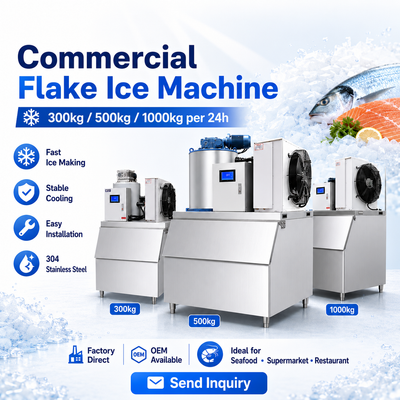
The sequence is the same, but flake machines have an auger and evaporation cylinder that must be included in the cycle. Flake machines used for seafood and produce display should be cleaned at the short end of the schedule table. Browse our flake ice machines for model-specific guidance.
Can hard water permanently damage the machine?
Yes. Untreated scale insulates the evaporator, blocks the distribution tube, and shortens compressor life. Filtration is far cheaper than replacement.
Related reading and equipment
- Ice Machine Not Making Ice? 12 Causes and Fixes
- Commercial Ice Machine Sizing Guide
- Flake Ice vs Cube Ice: Which One Do You Actually Need?
- Equipment: IM-198 commercial ice maker, 450 kg/day cube ice maker, 1000 kg industrial flake ice machine
Frequently Asked Questions
How often should I descale a commercial ice machine?
Descale every 6 months in soft-water areas and every 3 months in hard-water areas. Install a water filter or softener if you have more than 7 grains per gallon of hardness to extend the interval and protect the evaporator.
What is the best cleaner for an ice machine?
Use a nickel-safe ice machine cleaner that matches the evaporator type. Acidic cleaners remove scale; sanitizers kill bacteria. Axospro commercial units ship with a recommended cleaner and full cleaning procedure.
Is it safe to use vinegar to clean a commercial ice machine?
Vinegar can remove light scale but is not approved as a sanitizer for commercial food equipment and can leave odor. Use a commercial nickel-safe descaler and an approved sanitizer to meet health-department standards.
How do I sanitize the ice bin and scoop?
Wash the bin interior with a food-contact sanitizer, rinse with potable water and air-dry. Sanitize the scoop and holder daily and replace the scoop if it has cracks or residue. Many jurisdictions require a dedicated, sanitary scoop storage.