TL;DR — Quick Answer
Flake ice for seafood, meat processing and display beds. Cube ice for drinks service. If you do both seriously, run two machines rather than compromising on one.
- Flake ice: dry, subcooled crystals 1–2 mm thick with no sharp edges, about 1–2 °C colder than cube ice at the moment it leaves the machine.
- Cooling speed: flake wins — full contact surface pulls temperature down fast.
- Melt rate in a drink: cube wins — flake has more surface area per kilogram, so it melts faster and dilutes.
- Product damage: flake wins — no sharp corners means no bruising on fish fillets, shellfish or soft produce.
- Running cost: flake machines use slightly more energy per pound because the ice is made at a warmer temperature.
- Storage: flake compacts over time and is best used the same day it is made.
Flake ice is the right choice for seafood, meat processing and display beds, because its thin flat crystals pack around product and cool it fast without bruising. Cube ice is the right choice for drinks service, because it melts slowly and does not dilute. If your operation does both, run two machines rather than compromising on one.
What flake ice actually is
Flake ice is produced by freezing a thin film of water on a vertical evaporator and scraping it off with a rotating blade. The result is dry, subcooled crystals around 1 to 2 mm thick with no sharp edges. It is typically 1 to 2 C colder than cube ice at the moment it leaves the machine, and it moulds to the shape of whatever it touches, which is why it cools uneven surfaces so effectively.
Flake ice versus cube ice
- Cooling speed: flake ice wins. Full contact surface means faster temperature pull-down, which matters for freshly caught fish and for chilled display.
- Melt rate in a drink: cube ice wins. Flake ice has more surface area per kilogram, so it melts faster and dilutes a drink.
- Product damage: flake ice wins. No sharp corners means no bruising on fish fillets, shellfish or soft produce.
- Storage density: roughly comparable, though flake ice compacts over time and should be used the same day it is made.
- Machine cost per kg of output: cube ice machines are cheaper at the same daily capacity, which is why buying flake ice for drinks service wastes money.
Where flake ice earns its cost
- Seafood landing and transport: layer fish in flake ice immediately after catch. Rapid pull-down extends shelf life by hours, which converts directly into price at market.
- Supermarket display: a flake ice bed keeps fish and shellfish visibly chilled and fresh-looking without freezing the surface.
- Meat and poultry processing: flake ice controls temperature during grinding and mixing, where any heat build-up risks bacterial growth.
- Concrete and chemical cooling: flake ice is dosed directly into batch mixes for temperature control. This is an industrial use where cube ice cannot substitute.
How much flake ice do you need
Work in kilograms per 24 hours and add headroom, because rated output is measured at standard ambient and water temperatures. If your site runs hot, real output drops.
- Small fish counter or seafood stall: 300 kg per 24 hours.
- Medium seafood processor or large supermarket: 500 kg per 24 hours.
- Industrial processing, chemical cooling or central distribution: 1000 kg per 24 hours and above, often with a separate storage bin.
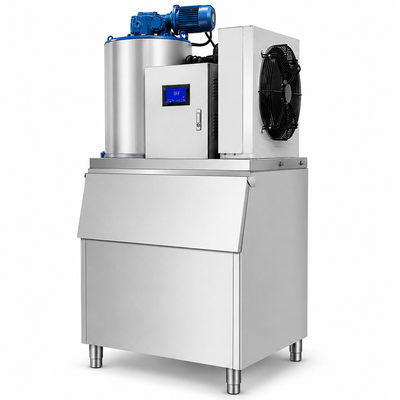
Note that industrial flake ice makers are normally sold as the machine head only. Budget for a matched ice storage bin, and confirm the bin capacity separately, because this is the single most common source of disagreement at delivery.
Frequently asked questions
Can flake ice be used in drinks? It can, but it melts quickly and waters down the drink. Use it for blended and frozen drinks, not for a standard served soda or cocktail.
Does flake ice need a water line and a drain? Yes. Every flake ice machine needs a potable water supply and a drain close to the unit. Plan both before installation.
Is a storage bin included? Usually not on industrial models. Confirm what is in the crate before ordering so the machine is not sitting idle on arrival.
Choosing your model
Axospro builds flake ice machines at 500 kg per 24 hours, 1000 kg per 24 hours, and a 300 to 1000 kg range for operations still sizing their requirement. Tell us your daily volume, ambient temperature and water conditions and we will confirm the right capacity and send the full specification.
Frequently Asked Questions
What is the main difference between flake ice and cube ice?
Flake ice is soft, moldable and held at about -7 C (19 F); it conforms around products and is the standard for seafood displays, salad bars and healthcare. Cube ice is hard, clear and slower-melting, the standard for beverages and general foodservice.
Which ice is better for seafood displays?
Flake ice is the industry standard for fresh seafood on ice because it conforms around fish, holds temperature evenly and presents better. Cube ice leaves air gaps, melts faster and can bruise delicate fish.
Which ice type melts faster?
Flake ice melts faster than cube ice because of its higher surface-area-to-volume ratio. For beverages where you want the drink to stay cold without dilution, cube ice is better. For rapid cooling and display, flake ice wins.
Are flake ice machines more expensive to run?
Flake ice machines use slightly more energy per pound than cube machines because flake is produced at a warmer temperature with thinner ice. The trade-off is usually worth it for the display, blending and conformability benefits.