TL;DR — Quick Answer
A commercial ice machine that stops making ice almost always has one of three faults: no water reaching the evaporator, no power or a failed control, or a refrigeration problem. Check water, power and room temperature first — those are free to fix.
- Five-minute triage: confirm the shut-off valve is fully open and the line is not kinked; confirm the machine is plugged in, the breaker is on and the switch is set to ICE; confirm the room is inside the rated ambient range (≈50–100 °F).
- A closed valve during cleaning is one of the most common no-ice call-backs.
- Dirty condenser: if the room exceeds the heat-rejection capacity, the freeze cycle extends or stops. Vacuum the condenser monthly in dusty environments.
- Blank display: test the outlet with another device before calling a technician.
- Call a technician when: you see refrigerant leaks, repeated freeze-cycle alarms, water leaks inside the cabinet, electrical faults, or output does not recover within 24 hours of a full clean and filter change.
Short answer: When a commercial ice machine stops making ice, the cause falls into one of three groups: no water reaching the evaporator, no power or a failed control component, or a refrigeration fault such as a dirty condenser, low refrigerant or a weak compressor. Check water supply, power and room temperature first — those three are behind the majority of no-ice service calls and cost nothing to fix.
This guide is written for owners and managers of restaurants, bars, cafes, hotels and seafood counters who need to get a machine running again today. Work through the triage first, then match your symptom in the table.
Start with a five-minute triage
Before removing any panel, rule out the three cheap causes.
- Confirm the water supply. Make sure the shut-off valve behind the machine is fully open, the incoming water line is not kinked, and the building water is on. A closed valve during cleaning is one of the most common no-ice call-backs.
- Confirm power and the mode switch. Check that the machine is plugged in, the breaker has not tripped, and the control switch is set to ICE rather than WASH or OFF. If the display is blank, test the outlet with another device.
- Check the room temperature. Air-cooled machines are rated for a defined ambient range, typically around 50°F to 100°F (10°C to 38°C). A unit installed beside a fryer, in direct sunlight, or inside an unventilated closet can lose a large share of its rated output and may stop producing ice entirely.
If all three check out, move to the symptom sections below.
Symptom 1: No ice at all
Blocked water filter or inlet screen
A clogged filter or a scaled inlet screen starves the machine. Replace the filter cartridge if it has been more than six months, and clean the inlet screen with a brush.
Failed water inlet valve
If you hear no hum when the machine calls for water, the solenoid coil may be burnt out. This is a common, inexpensive part, but it requires a technician to fit and test safely.
Stuck float switch or level sensor
Scale buildup can stop the float from dropping, so the control board believes the reservoir is already full. Removing and descaling the float usually restores production.
Faulty control board or bin thermostat
If the display shows power but no components start, the board, the bin thermostat or the safety limit switch may be the problem. This is technician territory.
Symptom 2: Production has dropped but the machine still runs
Dirty condenser
Grease, flour and dust on the condenser fins is the single most common cause of slow production. Brush or vacuum the fins and use a condenser cleaner; never blast them with a pressure washer, which bends the fins.
Low refrigerant
A slow leak shows up as long freeze cycles, thin or incomplete cubes, and frost in unusual places. Only a licensed refrigeration technician should locate the leak, repair it and recharge the system.
Weak water pump or clogged distribution tube
If water dribbles rather than sprays over the evaporator plate, the pump is failing or the distribution tube holes are scaled. Clean or replace the tube and check pump output.
Scale on the evaporator
Hard water leaves mineral deposits that insulate the evaporator and make cubes stick. A full descale cycle, not just a wipe, is required. See our step-by-step cleaning and descaling guide.
Symptom 3: Ice is soft, cloudy, hollow or misshapen
- Soft or slushy cubes — usually low refrigerant, a failing hot gas valve, or ambient temperature above the rated range.
- Cloudy or white cubes — dissolved minerals in the water. Fit or replace a properly sized water filter and descale the evaporator.
- Hollow or incomplete cubes — low water level in the reservoir, a partially blocked distribution tube, or a pump losing pressure.
- Cubes stuck on the evaporator — scale prevents release. Descale, then run two full batches and discard them.
Symptom 4: Ice is produced but melts in the bin
If the machine makes ice but the bin is empty in the morning, suspect heat rather than production. Check that the bin drain is not letting warm air in, that the lid or door seals properly, and that the bin thermostat is not holding the bin too warm. In a hot kitchen, an undersized bin is the real problem — the fix is either more storage capacity or a higher-output head.
Symptom 5: Leaks, unusual noise, or error codes
- Water on the floor — check the bin drain connection, the incoming line fittings, and the water pump seal.
- Loud grinding or buzzing — often a failing fan motor, pump bearing or compressor mount.
- Repeated error codes — note the exact code and the moment it appears; this saves the technician significant diagnostic time.
Diagnostic table: symptom to cause to action
| Symptom | Most likely cause | What to check first | DIY or technician |
|---|---|---|---|
| No ice, display dark | No power | Outlet, breaker, plug, mode switch | DIY |
| No ice, display lit | No water / stuck float | Shut-off valve, filter, float movement | DIY |
| Slow production | Dirty condenser | Fin condition, airflow clearance | DIY |
| Slow production, long cycles | Low refrigerant | Frost pattern, compressor run time | Technician |
| Cloudy cubes | Hard water / scale | Filter age, evaporator surface | DIY with descaler |
| Hollow cubes | Low water level or blocked tube | Reservoir level, spray pattern | DIY |
| Soft, wet ice | High ambient or low charge | Room temperature, condenser | DIY then technician |
| Ice melts in bin | Bin too small or warm air ingress | Drain connection, lid seal, bin size | DIY |
| Water leak | Loose fitting or failed pump seal | Inlet, drain, pump housing | Technician |
| Grinding noise | Fan or pump bearing | Fan blade freedom, pump noise | Technician |
| Error code on display | Control fault | Record code and timing | Technician |
| Seasonal output drop | Ambient temperature | Room temperature, ventilation | DIY |
Repair or replace? A simple rule
Use this rule of thumb: if the machine is more than seven years old and the quoted repair exceeds half the cost of a new unit, replacing it is usually the better financial decision. Newer machines also use less energy and water per kilogram of ice, so the payback is faster than the sticker comparison suggests.
| Unit age | Repair cost vs. replacement | Recommendation |
|---|---|---|
| Under 3 years | Any | Repair — parts are usually covered by warranty |
| 3 to 7 years | Under 30% | Repair |
| 3 to 7 years | 30% to 50% | Compare energy use before deciding |
| Over 7 years | Over 50% | Replace |
| Any age | Compressor failure | Strongly consider replacing |
Preventive schedule that avoids most of these calls
- Every day: keep the bin lid closed, keep the area around the machine clear.
- Every two weeks: wipe the bin interior and the exterior panels; check the drain.
- Every month: inspect and brush the condenser fins; check the water filter gauge.
- Every three to six months: full clean and descale cycle, more often in hard-water areas.
- Every six months: replace the water filter cartridge; have a technician check refrigerant charge and electrical connections.
For the full cleaning procedure, see How to Clean a Commercial Ice Machine.
Frequently asked questions
Why is my ice machine making ice but not dropping it into the bin?
Usually scale on the evaporator is preventing the cubes from releasing, or the harvest cycle is being cut short by a hot gas valve problem. Descale first; if the slabs still stay on the plate, call a technician.
How often should a commercial ice machine be cleaned?
Every three to six months for most sites. In hard-water areas, or in venues running the machine near capacity, clean every two to three months.
Can I run a commercial ice machine on a standard 115V circuit?
Small undercounter units commonly do. Machines above roughly 150 kg per day usually need a dedicated 208-230V circuit. Always confirm the nameplate rating before ordering — see our installation requirements guide.
How long should a commercial ice machine last?
With regular cleaning and a maintained water filter, seven to ten years is a realistic expectation. Skipping descaling is the fastest way to shorten that.
Is it normal for output to drop in summer?
Yes. Air-cooled machines produce less ice as ambient temperature rises, which is why manufacturers quote output at a reference temperature such as 21°C water and 21°C room. Size with a summer margin rather than an annual average.
What size machine do I actually need?
Start from peak daily demand plus a storage buffer, not from the average. Our commercial ice machine sizing guide walks through the calculation, or browse our commercial cube ice makers and flake ice machines.
Related reading and equipment
- How Much Ice Does Your Business Need? Sizing Guide
- Flake Ice vs Cube Ice: Which One Do You Actually Need?
- Commercial Soft Serve Machine Buying Guide
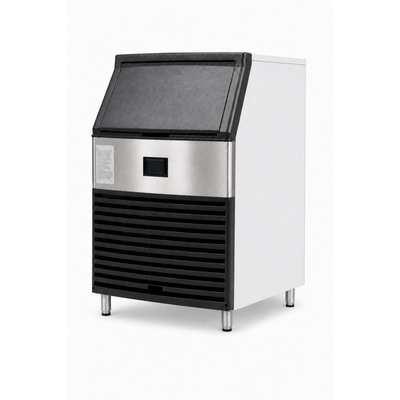
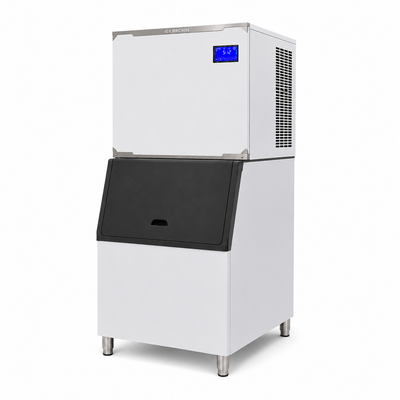
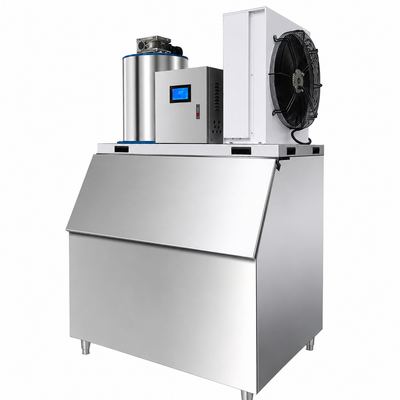
- Equipment: 95-110 kg/day cube ice machine, 450 kg/day cube ice maker with 200 kg bin, 500 kg flake ice machine, 1000 kg industrial flake ice machine
All Axospro machines ship from our US warehouse with a commercial warranty and English technical support.
Frequently Asked Questions
Why is my ice machine running but not producing ice?
Common causes are restricted water supply, a clogged water filter, low room temperature around the unit, a faulty thermistor or a scaled evaporator. Start with the simplest checks: water pressure, filter age, and condenser coil cleanliness.
What does it mean when the ice machine is full but no ice drops?
The bin-full sensor, curtain switch or thermostat may be stuck or failed. Inspect the curtain, clean the bin sensor eye and verify the bin thermistor. If the controller still reads 'full' when empty, replace the sensor.
Could a dirty condenser stop ice production?
Yes. A condenser blocked with dust loses heat-rejection capacity, the freeze cycle extends and the machine may stop harvesting ice. Vacuum the condenser monthly in dusty environments and keep the area around the unit clear of debris.
When should I call a technician for ice machine repair?
Call a technician if you see refrigerant leaks, repeated freeze-cycle alarms, water leaks inside the cabinet, electrical faults, or if a thorough clean and filter change do not restore output within 24 hours. Continued running can damage the compressor.