TL;DR — Quick Answer
For a busy shop, look for 18–25 L/h output, 5–7 L of mix per hopper and a dedicated 110V or 220V circuit. Below 16 L/h you will queue customers; above 30 L/h is usually wasted spend.
- Up to 100 servings/day: countertop unit rated 16–25 L/h.
- 100–300 servings/day: 25 L/h or higher, with a refrigerated hopper.
- 300+ servings/day: run two machines rather than one oversized unit, so a single service call never stops all sales.
- Yield: one litre of mix gives roughly 8–10 standard cones, so a 25 L/h machine covers about 150 cones an hour in real service with recovery time.
- Current draw: single-head and small twin units typically draw 15–20 A at 110V/60Hz; larger floor twins and triples need a dedicated 20 A or 30 A circuit.
- Drainage: machines with auto-wash need a drain; manually cleaned countertop units may not.
- Bench check: verify the counter carries the full working weight before ordering a countertop model.
A commercial soft serve machine for a busy shop should produce 18 to 25 litres per hour, hold at least 5 to 7 litres of mix per hopper, and run on a dedicated 110V or 220V circuit. Machines rated below 16 L/h will queue customers during peak service; capacity above 30 L/h is usually wasted spend unless one unit feeds several outlets.
1. Start with hourly output, not price
Output is measured in litres per hour (L/h). It is the single number that decides whether a machine keeps up with your rush.
- Up to 100 servings a day (cafe, small dessert kiosk): a countertop unit rated 16 to 25 L/h is sufficient.
- 100 to 300 servings a day (ice cream parlour, food court): choose 25 L/h or higher with a refrigerated hopper.
- More than 300 servings a day: run two machines rather than one oversized unit, so a single service call never stops all sales.
One litre of mix yields roughly 8 to 10 standard cones. A 25 L/h machine therefore covers about 200 to 250 cones per hour of continuous running, and a realistic 150 cones an hour in real service with recovery time included.
2. Countertop or floor-standing
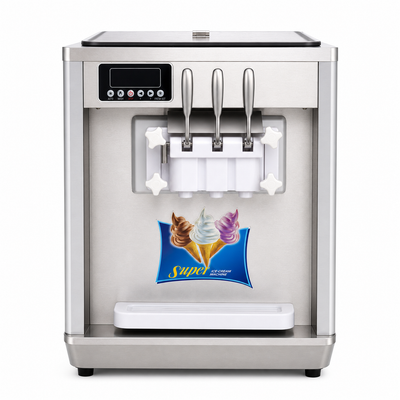
Countertop units sit on an existing bench and suit sites where prep space is tight. Check two things before ordering: the bench must carry the full working weight (a compact countertop soft serve machine weighs around 108 kg, so allow 120 kg or more), and you need clearance above the unit to lift the hopper lid.
Floor-standing machines free the bench entirely and usually carry larger hoppers and a stronger gearbox. They suit parlours serving all day. The trade-off is footprint: allow roughly 520 x 740 mm of floor space plus service access at the back.
3. Hopper capacity and pre-cooling
The hopper holds liquid mix before it enters the freezing cylinder. Bigger hoppers mean fewer refills during service. More importantly, a refrigerated hopper keeps leftover mix below 5 C overnight, so mix can be held safely instead of being discarded at closing. On a machine without pre-cooling, staff pour away several litres of mix every night, which quietly costs more than the machine itself over a year.
4. Power and site requirements
Most commercial soft serve machines draw between 1.5 kW and 2.5 kW. Confirm three things with your electrician before delivery:
- Available voltage and frequency at the site (110V 60Hz in North America, 220V 50 or 60Hz in most other markets).
- A dedicated circuit sized for the running current, typically 20 A.
- Ventilation clearance around the condenser. Machines with front-breathing ventilation can sit flush against a wall and save meaningful floor space.
5. Cleaning, and what it really costs you
Soft serve machines contact dairy, so they must be disassembled, washed and sanitised daily. Budget 20 to 30 minutes of closing time. Two design details change that number a lot: tool-free disassembly and a built-in wash or rinse cycle. Both are worth paying for, because labour is the largest hidden cost of owning this equipment.
Frequently asked questions
How long does a commercial soft serve machine take to freeze the first batch? Most units reach serving consistency in 12 to 15 minutes from cold start, so switch the machine on before opening rather than at the first order.
Can one machine serve two flavours and a twist? Yes. A standard three-head configuration gives two single flavours plus a twist, because the centre head blends both cylinders.
What is the realistic payback period? At 50 servings a day with a 4 USD ticket and a typical 25 to 30 percent ingredient and overhead cost, a mid-range machine pays for itself in roughly one to two months of steady trade.
Choosing your model
If you need a compact countertop unit, the Axospro BQL-808-1 delivers 18 to 25 L/h from a 518 x 740 mm footprint. For higher volume or a full-height station, the Axospro BQL-A22-1 adds a taller cabinet and 135 kg of stability for continuous service. Both include refrigerated hoppers, 2-year warranty and lifetime technical support.
Frequently Asked Questions
How much output do I need from a soft serve machine?
Estimate peak-hour servings and pick a machine with 1.3 to 1.5x that capacity. For a cafe selling 40 cups an hour at peak, a 60 L/h machine is the right starting point. Floor twins cover busy shops and chains; countertops cover cafes and bars.
Single-head, twin or triple - which configuration?
Single-head (one flavor + optional twist) suits small cafes. Twin (two flavors + twist) is the most common and supports menus with two best-sellers. Triple-head adds a third flavor line, used for self-serve, frozen yogurt and high-volume menus.
Does a soft serve machine need a water line?
Most soft serve machines have a self-contained refrigerated hopper and do not require a water line for operation, but they need a drain for the cleaning cycle and auto-wash. Countertop units with manual cleaning may not need a permanent drain.
How many amps does a commercial soft serve machine draw?
Single-head and small twin units typically draw 15 to 20 amps at 110V/60Hz in North America. Larger floor twins and triples need a dedicated 20A or 30A circuit. Confirm the exact amp draw on the spec sheet before installation.