TL;DR — Quick Answer
Choose a countertop machine if counter space is your binding constraint or the machine has to travel; choose a floor-standing machine if you want it at standing height, need to keep the counter clear for prep, or serve a hard peak. On price the two are within about 11 percent of each other, so buy on layout and throughput rather than on cost.
- The price gap is small: $1,617.14 for the BQL-808-1 countertop vs $1,794.17 for the BQL-A22-1 floor-standing — a $177 difference
- Output is effectively the same: both run 18-25 L/h from 2 x 7 L hoppers, so you are not buying capacity
- Countertop wins on: food trucks, tight layouts, kiosks, and any site where the counter is already built and rated for the load
- Floor-standing wins on: service ergonomics, counter clearance, drip tray access and faster close-down
- Power is the same either way: every AXOSPRO machine ships 110 V / 60 Hz with a NEMA plug — but put it on a dedicated circuit
- Buy for your peak hour: size to the busiest hour, not the daily average, or the compressor will run flat out all day
What is the difference between a countertop and a floor-standing soft serve machine?
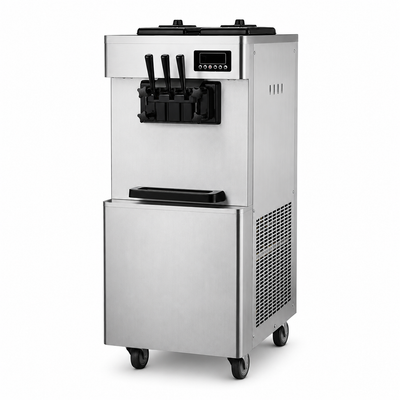
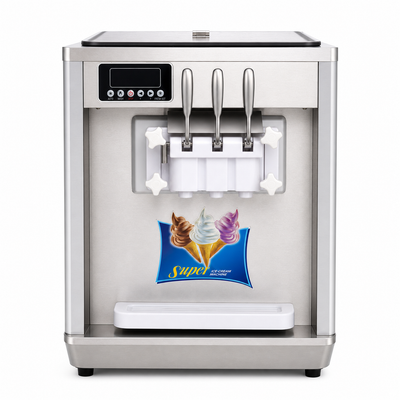
The difference is where the machine stands and how you serve from it, not how much it produces. A countertop unit sits on a counter or a stand; a floor-standing unit is a full-height cabinet on its own base. At AXOSPRO both formats are available at essentially the same output — the BQL-808-1 countertop and the BQL-A22-1 floor-standing machine are both rated 18–25 L/h with 2 × 7 L hoppers.
That matters because most buyers assume the bigger-looking machine makes more ice cream. Usually it does not. What changes is the working height, the floor or counter space consumed, and how much of your counter stays free for everything else you need to do during service.
How much more does a floor-standing soft serve machine cost?
About $177 at AXOSPRO — $1,617.14 for the countertop BQL-808-1 against $1,794.17 for the floor-standing BQL-A22-1. That is an 11 percent premium, which is small enough that budget should rarely decide the question.
Where money does enter the decision is installation. A countertop machine may need the counter reinforced; a floor-standing machine needs level, load-bearing flooring and a route to a drain or a drip tray you empty by hand. Both need a dedicated circuit. If you are fitting out a new site, decide the layout first and let the layout pick the format.
How much counter space does a countertop soft serve machine need?
Enough for the footprint plus clearance on the vented sides — and the counter has to carry the weight. Air-cooled machines reject heat through the cabinet, and a machine pushed into a tight alcove will run hot, freeze slowly and eventually trip. Clearance is not optional slack; it is part of the specification.
For scale, the compact end of the range is well defined: the G10L2 slush machine is built to fit a 400 mm counter gap. Soft serve machines are larger and heavier, so measure your run, then check the dimensions and weight on the product page before you order rather than after it arrives.
Which output should you buy for your peak hour?
Buy for the busiest hour you expect, not your daily average. A machine rated 18–25 L/h will keep up with steady all-day trade in a cafe or dessert bar. If your demand comes in a short hard rush — a stadium, a school break, a festival — the hoppers empty faster than the freezing cylinder can recover, and you get soft product and a queue.
For those sites the step up is the 16–32 L/h class: the BQL-838-2 (floor standing) or the BQL-A11-6 (countertop) at $1,800. Continuously running any machine at its limit shortens compressor life far more than occasional peaks, so headroom is cheaper than a replacement.
Does a floor-standing machine need special flooring or power?
It needs level flooring that carries the load; the power requirement is unchanged. Every AXOSPRO machine ships configured for North American electrical service — 110 V / 60 Hz with a NEMA plug — so there is no electrician visit to rewire an outlet. What you do need is a dedicated circuit, because a compressor sharing a circuit with a coffee machine or a combi oven will nuisance-trip at the worst possible moment.
Neither format needs a plumbed water line or a floor drain. Soft serve machines are fed mix by hand; you need a sink nearby for rinsing parts. That is a genuine saving against ice machines, which need both a supply and a drain line.
Which is better for a food truck or a small cafe?
A food truck should buy countertop, almost without exception. Space is the binding constraint, the machine has to be secured for transit, and every kilogram sits against your payload limit. A countertop unit like the BQL-808-1 or BQL-A11-6 fits that reality.
A small cafe with a fixed counter can go either way, and the tie-breaker is usually what else has to happen on that counter. If the same surface has to hold the till, the cups and the prep, the floor-standing machine buys you back the most valuable square metre in the room. If the counter is dedicated and already rated for the load, countertop keeps the capital cost down and the machine within easy reach.
Which one is easier to clean?
Floor-standing machines are slightly easier to close down; countertop machines are easier to deep-clean. The daily cycle is the same for both — rinse, drain, disassemble the dispense parts, sanitise, reassemble — and the frequency is set by your local health rules, not by the manufacturer.
Where they differ is ergonomics. A floor-standing cabinet gives you a larger drip tray, better access around the dispense head and a comfortable working height, which shortens the nightly close. A countertop machine is lighter and its parts are easier to carry to a sink for the weekly deep clean. Pick the one that fits the person who will actually be closing the machine down at eleven at night.
Full cleaning procedure: commercial ice cream machine cleaning and maintenance.
So which should you buy?
If you are still undecided, the decision usually resolves itself on one question: do you need the counter back? If yes, buy floor-standing. If no — or if the machine has to move, travel, or fit a space that is already built — buy countertop. The $177 difference is not worth a week of deliberation, and both machines carry the same 2-year parts and compressor warranty and the same lifetime technical support.
Compare the current range: all AXOSPRO soft serve machines, or read the wider soft serve buying guide.