TL;DR — Quick Answer
Size a soft serve machine on your busiest single hour, not your daily average — then add a 1.5x safety buffer.
- Sizing rule: count 100 ml portions in your busiest 60 minutes, then multiply by 1.5.
- 30–60 portions/hour peak: a countertop machine is usually right (cafes, food trucks, dessert counters).
- 100+ portions/hour peak: choose a floor-standing unit with larger hoppers and faster recovery.
- Countertop: sits on an existing bench, zero floor footprint, typically 18–25 L/h, 2 x 7 L hoppers.
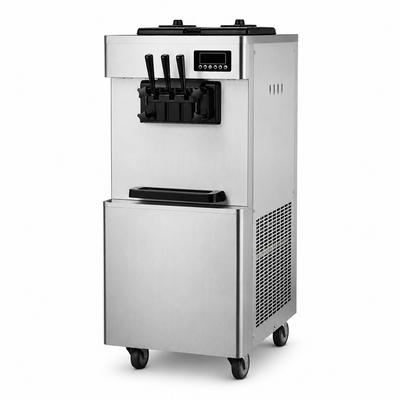
- Floor-standing: needs dedicated floor space and clearance, handles 18–25 L/h and above.
- Cooling: air-cooled units plug into a standard outlet; water-cooled units need a drain and water line but cool better in hot kitchens.
- Feed type: gravity feed is simpler; pump feed gives faster production and precise overrun control.
- Cleaning: rinse daily, deep-clean cylinders and seals weekly.
Choosing the right commercial soft serve machine in 2026 means matching real output, footprint, flavour flexibility and after-sales support to your business model. Buy too small and you lose sales during peak hours. Buy too large and you waste capital, electricity and floor space. This guide walks through every decision point so you can order once and serve profitably for years.
Start with your busiest hour, not your average day
Most sizing mistakes come from looking at daily totals instead of peak demand. Estimate how many 100 ml portions you sell during your busiest 60-minute window, then add a 1.5 safety buffer. If you expect 40 portions per hour at peak, size for 60. That buffer covers heat waves, holiday rushes and staff turnover slowdowns.
Small cafes, food trucks and dessert counters serving 30–60 portions per hour at peak usually do well with a countertop soft serve machine. Busy ice cream parlours, cinemas, restaurants and buffet stations serving 100 or more portions per hour need a floor-standing unit with larger hoppers and faster recovery.
Countertop vs floor-standing soft serve machines
| Factor | Countertop | Floor-standing |
|---|---|---|
| Best locations | Cafes, kiosks, food trucks, small parlours, dessert counters | Busy parlours, restaurants, cinemas, buffets, large cafeterias |
| Floor space | Sits on an existing counter, zero floor footprint | Requires dedicated floor space and clearance |
| Typical output | 18–25 L/h | 18–25 L/h and higher |
| Hopper capacity | 2 x 7 L is standard | 2 x 7 L and larger configurations |
| Example Axospro model | Axospro BQL-808-1 | Axospro BQL-A22-1 |
Why output and hopper capacity move together
A machine rated for 25 L/h sounds fast, but if the hoppers only hold 7 L each, the operator must refill roughly every two hours of continuous service. For a food truck that closes after lunch, that is fine. For a cinema running from noon to midnight, constant refills kill labour efficiency. That is why high-traffic sites choose floor-standing machines with the same or higher output but larger overall capacity and faster recovery between refills.
Flavour configuration: two single + twist covers most menus
Most commercial soft serve machines dispense two single flavours plus a twist. This covers roughly 80% of menus without confusing customers. If you plan rotating limited-time flavours, look for quick-drain hoppers and easy cylinder cleaning. Some premium machines have independent refrigeration circuits per hopper, which means one flavour can be cleaned while the other two keep running.
Gravity feed vs pump feed
Gravity-fed machines rely on liquid mix flowing from the hopper into the freezing cylinder. They are simpler, cheaper and easier to maintain. Pump-feed machines use a pump to push mix into the cylinder, giving tighter overrun control and slightly faster output. For small to medium locations, gravity feed is usually sufficient. For high-volume chains that need identical texture in every cone, pump feed is worth the extra cost.
Voltage, refrigerant and local codes
North American sites need 110V/60Hz with the correct NEMA plug. Many commercial machines also support 220V/50Hz for international markets. Confirm voltage before ordering to avoid expensive electrical work. Modern machines use R290 refrigerant, which is efficient and has low global-warming potential, but ventilation must meet local codes. Axospro ships each machine configured for the destination voltage and includes English setup manuals.
Build quality and warranty
Daily cleaning exposes every machine to moisture and dairy residue. Stainless-steel construction, sealed electronics and food-grade contact surfaces are non-negotiable. A 2-year commercial warranty is the industry minimum for reliable daily use. Axospro backs every soft serve machine with a 2-year warranty and lifetime technical support.
Regional voltage and plug guide
North America uses 110V/60Hz with NEMA 5-15 or 6-20 plugs. Europe and most of Asia use 220V/50Hz. Some machines are dual-voltage, but the plug and internal wiring must match your site. Axospro configures each machine for the destination voltage before shipping, so confirm your country when ordering. Using the wrong voltage voids the warranty and can damage the compressor.
What to compare across brands
When comparing machines from different suppliers, look beyond the headline price. Compressor brand and warranty length often predict reliability. Check whether the supplier stocks spare parts in your region and whether English manuals and video guides are available. Ask for real-world output under warm ambient conditions, not just laboratory ratings. Axospro publishes output based on typical commercial kitchen temperatures and backs every machine with a 2-year warranty.
Installation and setup timeline
Most countertop soft serve machines can be unboxed, leveled and plugged in within 30 minutes. Floor-standing units may need a day for positioning, electrical connection and water-line setup if required. Allow 24 hours for the refrigerant to settle before first use. Plan staff training on cleaning and refill procedures before opening day. Axospro provides English setup manuals and remote support during the first week.
Accessories and consumables to order at the same time
Order sanitizer, food-grade lubricant, spare O-rings and cone or cup holders with the machine. A digital thermometer helps verify product temperature during inspections. If you serve twist flavours, colour-coded handles reduce cross-contamination. Ordering these items together avoids delays once the machine arrives.
Soft serve machine buying checklist
- Measure peak-hour portion demand and add a 1.5 safety buffer.
- Choose countertop or floor-standing based on floor space and traffic.
- Confirm hopper and cylinder capacity match your refill frequency tolerance.
- Verify voltage, plug type and refrigerant for your region.
- Check that English manuals, replacement parts and remote support are available.
- Look for a 2-year commercial warranty as a minimum.
Maintenance costs over the machine life
Budget $200–$400 per year for seals, lubricant, sanitiser and occasional tap replacements. A well-maintained compressor rarely fails, but neglected seals and dirty cylinders lead to expensive repairs. Daily cleaning is the single biggest factor in total cost of ownership.
Common mistakes to avoid
Do not buy based on daily capacity alone. Do not ignore voltage compatibility. Do not assume one machine can run both soft serve and gelato. Do not skip daily cleaning, because dairy residue shortens machine life and creates health risks. Finally, do not underestimate freight costs and electrical work for larger floor-standing units.
Final recommendation
For most small to medium operators, the Axospro BQL-808-1 offers the best balance of output, footprint and price. It produces 18–25 L/h, fits on a counter and gives you two single flavours plus twist. For high-traffic parlours, restaurants and cinemas, the Axospro BQL-A22-1 delivers the same flavour flexibility in a floor-standing design built for continuous service.
Frequently asked questions
How long does a commercial soft serve machine last?
With proper daily cleaning and annual maintenance, a commercial soft serve machine lasts 7–10 years. The compressor and condenser are usually the longest-lasting components.
How much electricity does a soft serve machine use?
A 1.7 kW machine running continuously during an 8-hour shift uses roughly 13–14 kWh. Actual usage depends on ambient temperature, door openings and serving frequency.
Can I use a soft serve machine for frozen yoghurt?
Yes. Most soft serve machines handle ice cream, frozen yoghurt, gelato and sorbet mixes. Adjust the viscosity setting for each product.
How often should I clean a soft serve machine?
Daily cleaning is mandatory for health compliance. A full deep clean of cylinders and seals is recommended weekly.
Do I need a water line?
Some models are air-cooled and only need a standard electrical outlet. Water-cooled models require a drain and water line, but cool more efficiently in hot environments.
What is the difference between gravity and pump feed?
Gravity-fed machines rely on mix flowing down from hoppers. Pump-feed machines push mix with a pump, allowing faster production and more precise overrun control.
Can I install a soft serve machine myself?
Countertop air-cooled units usually plug into a standard outlet and can be installed by the operator. Floor-standing or water-cooled units may need an electrician and plumber.