TL;DR — Quick Answer
AXOSPRO is a North American supplier of commercial frozen dessert equipment. Machines are built by Jiangmen Gongly Machinery Co., Ltd., a commercial refrigeration factory established in 1999, and are stocked, crated and shipped from AXOSPRO's own U.S. warehouse — so U.S. buyers get domestic delivery with no customs clearance or import duties.
- Shipping: Ships from the U.S. warehouse, typically dispatched within 15 business days, then 3–7 business days in transit.
- Warranty: 2-year warranty plus lifetime technical support; common wear parts stocked in the U.S.
- Line-up: Soft serve machines, slush machines, cube and flake ice makers, popsicle machines and fried/rolled ice cream machines.
- Built for: Cafes, ice cream parlours, dessert shops, restaurants, bars, hotels, food trucks and equipment distributors.
Every few weeks we get the same call. A cafe owner has been quoted $9,000 for a soft serve machine they have seen listed elsewhere for half that. A bar manager has an ice maker down in the middle of summer and the importer who sold it to them no longer answers the phone. A new dessert shop has taken delivery of a beautiful machine — with a plug that does not match a North American outlet.
AXOSPRO exists because those three problems are structural, not accidental. This is what we set out to fix, and how the company is actually put together.
The three complaints we kept hearing
1. Identical machines, wildly different prices. The same 18–25 L/h soft serve unit, built on the same production line, is sold in North America under a dozen brand names at prices that differ by two or three times. Most of that gap is distributor margin, not engineering.
2. Support that disappears after the sale. Frozen dessert equipment is not cookware. When a machine goes down in July, a shop loses its highest-margin category every day it stays down. Too many buyers discover only then that spare parts ship from overseas on a six-to-eight week lead time.
3. Equipment that is not built for North American sites. Voltage, plug type, sanitation certification and ambient operating range all matter. Machines specified for other markets arrive requiring rework, and ETL or NSF documentation is often unavailable when a health inspector asks for it.
Our answer: factory direct, U.S. stocked, U.S. supported
AXOSPRO machines are manufactured by Jiangmen Gongly Machinery Co., Ltd., a commercial refrigeration factory established in 1999 that has produced frozen dessert and ice making equipment for international brands for more than two decades. AXOSPRO handles North American product selection, documentation, inventory, warranty and technical support.
That structure is deliberately boring, and it is what lets us make three promises that are easy to verify:
- Ships from the United States. Equipment is stocked, crated and dispatched from our U.S. warehouse. Domestic orders involve no customs clearance, no import duties and no freight forwarder. Orders are typically dispatched within 15 business days, with 3–7 business days in transit depending on location and whether the shipment moves as LTL freight.
- Parts and people you can reach. Common wear parts — O-rings, beaters, taps, compressors — are held in U.S. stock. Every machine carries a 2-year warranty covering parts and factory defects, plus lifetime technical support by email.
- North America-ready specification. 110V/60Hz configurations with NEMA plugs as standard across the range, with 220V/50-60Hz available where the site requires it. Every model ships with a published electrical spec sheet. AXOSPRO machines are not currently NSF- or ETL-listed, and we do not claim a listing we cannot document.
What Italian gelato taught us about the engineering
Gelato is the least forgiving product in the category, which makes it the best teacher. Three numbers decide whether a batch is silky or icy:
- Overrun of roughly 10–25%. Far less air than soft serve (40–60%) or hard ice cream (20–35%). Less air means more milk solids per spoonful — and far less room for error.
- Serving temperature of about -10 to -14 °C. Warmer than hard ice cream, which is held at -18 to -20 °C. That narrow band is what makes gelato taste aromatic rather than numb.
- A balanced sugar-to-fat ratio. Sugar controls how much of the water freezes. Move it by even half a percent and the texture shifts from creamy to gritty or soupy.
Hitting those numbers repeatedly is a machine problem, not a recipe problem. It requires stable evaporator temperatures, low-shear agitation that does not churn in unwanted air, and controls an operator can trust on a busy Saturday. Those requirements shaped the freezing systems we build today — including the ones that never touch gelato.
Designed around how a real shift runs
Specifications are easy to publish. What decides whether a machine earns its counter space is whether a fifteen-minute closing routine actually gets done at 11pm by a tired employee. So we optimise for:
- Cleaning that fits in a shift. Tool-free disassembly of hoppers, taps and seals; one cleaning language across the whole range so training new staff stays simple.
- Repeatable output. Consistent overrun and portion temperature across back-to-back cycles, not just on a demo unit.
- Serviceability. Parts that a technician can reach, and a support team that answers with a model number and a solution rather than a ticket reference.
Where AXOSPRO is today
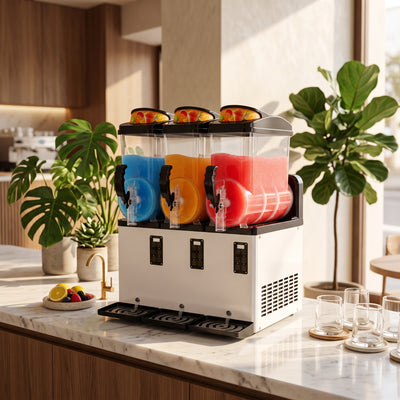
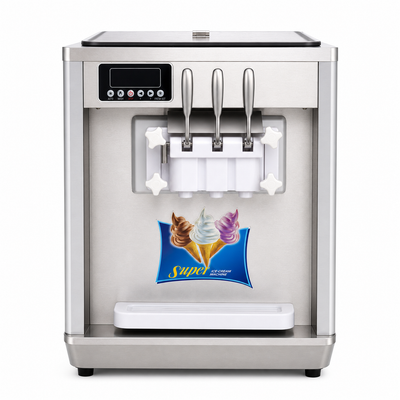
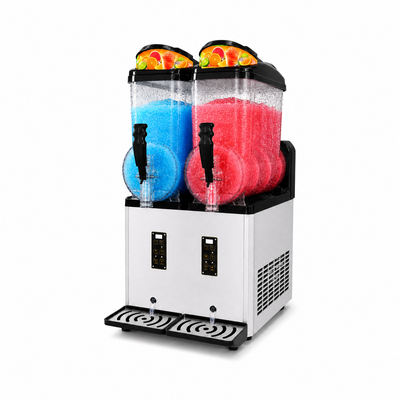
We supply soft serve machines, slush and frozen drink machines, cube ice makers, flake ice machines, popsicle machines and fried/rolled ice cream equipment to cafes, ice cream parlours, dessert shops, restaurants, bars, hotels, food trucks and equipment distributors across the United States.
Most customers start with a single countertop soft serve machine and add a slush machine once drinks take off. Because the whole range shares the same cleaning routines, controls philosophy and support channel, scaling up does not mean retraining your team.
If you are weighing up a purchase, start with the output you need in your busiest hour, then work backwards. Our soft serve buying guide and pricing breakdown cover the numbers in detail. Or email axosproinfo@gmail.com with your model shortlist and delivery location.
Frequently Asked Questions
Who manufactures AXOSPRO machines?
AXOSPRO machines are manufactured by Jiangmen Gongly Machinery Co., Ltd., a commercial refrigeration factory established in 1999. AXOSPRO is the North American brand responsible for product selection, documentation, U.S. inventory, warranty and technical support.
Where do AXOSPRO machines ship from?
All orders ship from AXOSPRO's U.S. warehouse to addresses within the United States. There is no customs clearance or import duty on domestic orders. Buyers outside the U.S. are welcome to order using their own freight forwarder — we deliver to your U.S. forwarder at no extra charge.
How long does delivery take?
Orders are typically dispatched within 15 business days, followed by 3–7 business days in transit depending on your location and whether the shipment moves as LTL freight.
What warranty do AXOSPRO machines carry?
Every machine includes a 2-year warranty covering parts and factory defects, plus lifetime technical support. Common wear parts such as O-rings, beaters, taps and compressors are stocked in the United States.
Are AXOSPRO machines suitable for North American electrical supply?
Yes. Every AXOSPRO model is configured for North American electrical service: 110V/60Hz with a NEMA plug is the standard configuration, and 220V/50-60Hz is available where the site requires it. AXOSPRO machines are not currently NSF- or ETL-listed; the electrical spec sheet and the installation requirements for your model ship with the order. Confirm the electrical configuration before ordering.
What is the difference between gelato, soft serve and hard ice cream?
Gelato is churned slowly with about 10–25% overrun and served at roughly -10 to -14 °C. Soft serve is aerated to 40–60% overrun and served at about -6 to -8 °C straight from the machine. Hard ice cream sits in between at 20–35% overrun and is stored at -18 to -20 °C. Each product needs a different machine.