TL;DR — Quick Answer
A commercial slush machine costs $1,205-$1,447 at AXOSPRO, and the real decision is bowl count: two bowls if frozen drinks are an add-on, three if they are a menu category. Expect $0.30-$0.50 of concentrate per 12 oz serve against a $3-$5 ticket, so the machine pays for itself in a few hundred serves.
- G10L2 at $1,204.70: 2 bowls, 30 L total, fits a 400 mm counter gap — the compact choice
- G10L3 at $1,446.85: 3 independent bowls, dual slush / cold-drink mode — the versatile choice
- The $242 upgrade buys: a third flavour and the ability to sell iced drinks outside the slush season
- Salt: none. Compressor machines freeze the mix directly; salt belongs to old ice-bath machines
- What actually controls texture: sugar content of the mix — too little and the bowl freezes solid, too much and it never sets
- Gross margin per serve: roughly $2.50-$4.50 on a 12 oz serve at a $3-$5 ticket
- Independent bowls matter: you can shut one down on slow days instead of running all of them at a loss
How much does a commercial slush machine cost?
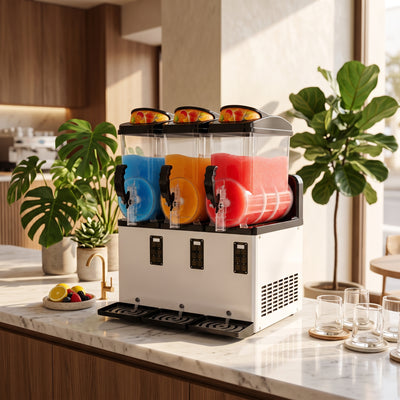
AXOSPRO commercial slush machines run $1,204.70 to $1,446.85. The G10L2 is the compact option: two bowls, 30 L total capacity, built to fit a 400 mm counter gap. The G10L3 adds a third bowl, independent bowl control and a dual mode that runs either slush or chilled drinks.
That $242 gap is the whole decision in one number. You are buying a third flavour and the ability to keep the machine earning outside the summer.
How many bowls do I need: 2 or 3?
Two bowls if frozen drinks are an add-on; three if they are a category you intend to promote. The test is simple: at your busiest moment, would you have to choose which flavour to drop? If yes, buy three.
There is a second, less obvious argument for three bowls: independent control. On the G10L3 each bowl runs on its own, so on a slow Tuesday you can run one bowl and leave two off rather than keeping all three at temperature for a handful of sales. That saves power, mix and wear, and it matters more over a year than the $242 does.
What is the difference between a slush machine and a granita machine?
Mechanically, very little — the difference is the texture you are aiming for and the recipe you run. Both hold a sweetened liquid at a temperature where it partially freezes and keep it agitated so it stays slushy instead of setting solid. Granita is coarser and more crystalline; slush is finer and smoother.
Because the two are mechanically so close, a machine with independent bowl control can run both textures side by side — a coarse granita in one bowl, a fine slush in another — which is a cheap way to widen the menu without buying a second machine.
How much salt do you put in a slush machine?
None — and this is one of the most common points of confusion. Modern commercial slush machines are compressor-driven: the refrigeration system freezes the mix directly in the bowl, so there is no salt anywhere in the process. Salt belongs to the old ice-and-salt-bath machines, where it lowered the melting point of the ice packed around a canister.
If you find a recipe telling you to add salt, it is describing that older equipment. What you do control is the sugar content of the mix. Sugar lowers the freezing point: too little sugar and the bowl freezes into a solid block that stalls the auger; too much and it never sets properly and you serve a sweet cold drink instead of a slush. Follow the concentrate ratio on the syrup, and if you are making your own mix, expect to adjust it once for your water and your room temperature.
How long does slush mix last in the machine?
Follow your local health department rule, not a rule of thumb from the internet. Many jurisdictions treat the contents of the bowl as a time/temperature-control-for-safety food and set an explicit holding limit. That rule wins over any manufacturer guidance.
The routine that keeps you on the right side of it: do not top up a partial bowl with fresh mix at close. Empty it, clean it, and start fresh the next day. Sugary mix sitting in a bowl overnight as it warms is the fastest route to a failed inspection, and no amount of stirring the next morning fixes it.
How do you clean a commercial slush machine?
Drain, rinse, disassemble the auger and taps, wash and sanitise every food-contact part, reassemble, run a rinse cycle. Do it on the schedule your local rules set rather than when the machine looks dirty — by the time it looks dirty you are already behind.
One thing to be strict about: never use abrasive pads or scourers on the bowls. Scratches are where bacteria survive sanitation, and they show up later as permanent clouding you cannot polish out. Warm water, a food-safe detergent, a soft cloth and a sanitiser are the whole kit.
How profitable is a commercial slush machine?
A 12 oz serve costs roughly $0.30–$0.50 in concentrate plus cup and lid, and sells for $3–$5 — call it $2.50–$4.50 gross per serve. Against a $1,204.70 machine, break-even lands in the low hundreds of serves, which for most sites is a handful of good trading days.
The margin story improves if you take the dual-mode option. A machine that can run chilled drinks as well as slush keeps earning through the months when nobody wants a frozen drink — iced coffee in autumn, chilled juice in spring. Spreading the payback over twelve months instead of four is usually worth more than the $242 upgrade costs.
See the current machines: AXOSPRO slush machines.