TL;DR — Quick Answer
Soft serve pays for itself on volume, not on margin per cup. Work out margin per serving, multiply by servings per day, and divide the machine price by that number. At the listed price of $1,617 for a BQL-808-1, roughly $150 of daily contribution pays the machine back in about eleven trading days.
- The formula: days to payback = machine price ÷ (servings per day × margin per serving)
- Worked example: $1,617 machine at $150 contribution a day ≈ 11 trading days
- What kills it: buying more capacity than you sell, and fixed costs that do not shrink with volume
- What helps: no plumbing required, so installation cost is near zero compared with ice machines
How much money does a soft serve machine make?
Soft serve is a high-margin product sold at a low ticket. The cost of the mix, cone and topping in one serving is small compared with what a customer pays, which is the appeal. But the absolute dollars per serving are also small, so the total depends on how many you sell.
That means the two questions that decide profitability are not about the machine at all: how many servings can you realistically sell in a day, and what will customers pay? The machine only decides your ceiling.
The numbers you need
Four figures, all of which you can get before you buy:
- Selling price per serving — what your market will pay.
- Cost of goods per serving — mix, plus cone or cup, plus any topping.
- Servings per day — be honest, and use your quietest realistic week.
- Fixed daily cost — the share of labour, rent and electricity attributable to the machine.
Contribution per serving is item 1 minus item 2. That is the money that pays for the machine. True profit per day is contribution times servings, minus the fixed daily cost.
Worked example — countertop soft serve
These are illustrative figures so you can see the method, not a forecast. Substitute your own numbers.
| Machine (BQL-808-1, listed price) | $1,617 |
| Output | 18-25 L/h |
| Servings per day (example) | 60 |
| Contribution per serving (example) | $2.50 |
| Daily contribution (example) | $150 |
| Days to pay back the machine | about 11 trading days |
Halve the servings and you double the payback to roughly three weeks of trading. The point of the table is not the answer — it is that payback moves with volume, and volume is the one number only you can estimate.
What actually kills the margin
- Overbuying capacity. A bigger machine costs more to buy and to run. It only wins if the extra output is sold.
- Underestimating the clean. The daily break-down and clean is real labour. If it is not in your model, your margin is overstated.
- Waste from poor rotation. Discarded mix is margin thrown away. Size orders to your actual throughput.
- Pricing to the ingredient, not to the market. Customers do not know what your mix costs. Price to what the location will bear.
Why soft serve is cheap to install
Soft serve machines are poured, not plumbed: the mix goes in the hopper by hand. No water line, no floor drain, no drain pump. Compare that with a cube ice maker, which needs a potable cold water supply and a separate drain line, and the installation cost difference is substantial — often hundreds of dollars in plumbing that a soft serve machine simply does not require.
What it does need is the right electrical supply. AXOSPRO machines are configured for North American electrical service: 110 V / 60 Hz with a NEMA plug, with 220 V / 50-60 Hz available on request. Have an electrician confirm the circuit before delivery rather than after.
Related reading
- What commercial machines cost
- Best machine for a food truck or small shop
- Rent or buy?
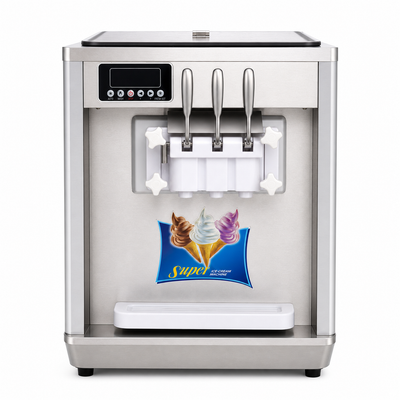
- BQL-808-1 countertop soft serve machine
Frequently asked questions
How profitable is soft serve?
Soft serve is a high-margin, low-ticket-per-customer product: the mix and cone cost per serving is small relative to what customers pay, which is why it is a staple add-on in cafés, dessert shops and buffets. The margin is real, but it is small in absolute dollars per serving, so profit depends on volume and on buying a machine sized to the volume you can actually sell.
How long does a soft serve machine take to pay for itself?
Divide the machine price by your daily contribution — servings per day multiplied by margin per serving. At the current listed price of $1,617 for a BQL-808-1, a shop clearing $150 of contribution a day pays the machine back in about eleven trading days. At $50 a day it takes about a month of trading. The formula matters more than the example: plug in your own servings and your own prices.
What does it cost to run a soft serve machine?
Four things: the mix and consumables, electricity for the compressor and beater, water and sanitiser for cleaning, and labour for the daily clean. Consumables scale with volume; electricity, cleaning and labour largely do not, which is why margin per serving improves as volume rises.
What margin per serving should I expect?
Work it out from your own prices rather than using an industry average: take your selling price, subtract the cost of the mix per serving, the cone or cup, and any topping, and what is left is your contribution. Then subtract the daily fixed costs — labour for cleaning, electricity, rent attributable to the footprint — to get true profit.
Is a bigger machine more profitable?
Only if you sell the extra volume. A larger machine costs more to buy and more to run, and it only wins if the extra capacity is sold. Buy for your busiest hour, and step up a size when you are turning customers away rather than when you hope to attract them.
Does a soft serve machine need plumbing?
No. The mix is poured in by hand, so there is no water line and no floor drain required. That is why soft serve is often the cheapest frozen dessert category to install — you need a level counter, the right electrical supply, and a sink nearby for cleaning.
AXOSPRO support: 8245 105th Ave, Vero Beach, FL 32967 · vliang@axospro.com · 1-772-258-0386
Related reading from the AXOSPRO blog
- Soft Serve Machine Daily Opening & Closing Procedure (SOP)
- Soft Serve Machine Water Cooling vs Air Cooling: Which to Choose
- Where to Place a Commercial Soft Serve Machine: Ventilation, Noise & Clearance
- Slush Machine Daily Cleaning & Syrup Rotation SOP
- Soft Serve vs Frozen Yogurt: Can One Machine Do Both?